
The TIRF team is commited in solving the following challenges:
- Providing a mathematical morphology-related Modern C++ library that conciliates ease-of-use, performance and genericity
- Developing high-performance mathematical morphology algorithms (mostly related to hierarchical image representations) that exploit the massively parallel architectures (e.g. GPUs) to gain efficiency and achieve state-of-the-art performance in this field.
Pylene is a fork of Milena, an image processing library targeting genericity and efficiency. It provided mostly Mathematical Morphology building blocs for image processing pipelines. The library has the following objectives in mind:
- Simplicity: both python bindings and simple C++ syntax
- Efficiency: write algorithms in a simple way and run them as if they were written in C. We follow one guideline: zero-cost abstraction.
- Genericity: write algorithms that are able to run on many kind of images with, yet, zero-cost abstraction.
- Interopability: run pylene algorithms on image coming from external libraries (even on your own image type).
Link to Gitlab project.
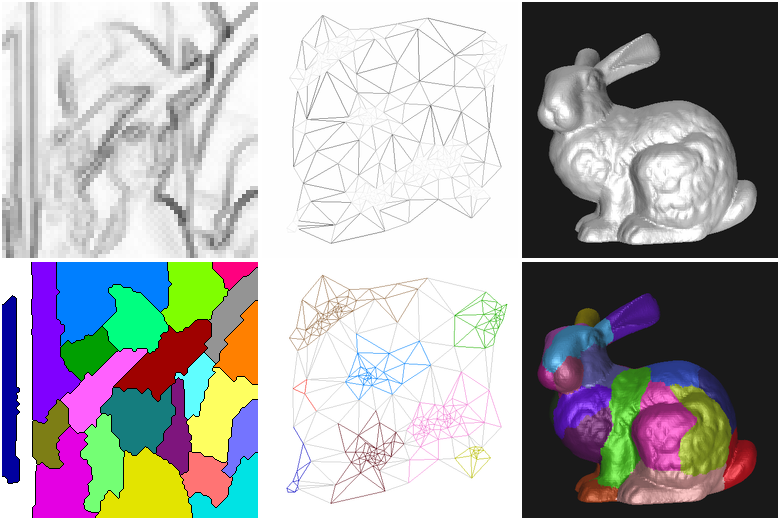
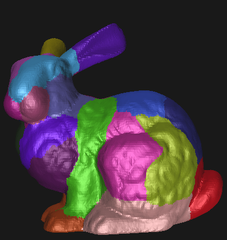
Generic image processing with Pylene: an algorithm is written once to process many kinds of images (regular 2D images, graphs and meshes).
